india national cricket team vs england cricket team timeline
Introduction: India National Cricket Team vs England Cricket Team Timeline
The rivalry between the India national cricket team and the England cricket team is one of the most profound, culturally rich, and historically significant contests in international sports. Spanning over nine decades, it is far more than a sequence of matches; it is a narrative of colonial inheritance, post-independence identity, tactical evolution, and sporting mutual respect. When India toured Lord’s in June 1932, they did so as a representative side under British administration, wearing whites and carrying the weight of a subcontinent learning a foreign game. Fast forward to the 2020s, and India stands as a global cricketing superpower, boasting a formidable pace attack, world-class spinners, and a deep batting lineup capable of dominating in any condition. England, meanwhile, has undergone its own transformation, shifting from traditional, methodical Test cricket to the aggressive, high-risk “Bazball” philosophy that has redefined modern batting.
Table of Contents
Early Encounters (1932–1947): Laying the Foundation
The 1932 Lord’s Test: India’s Baptism by Fire
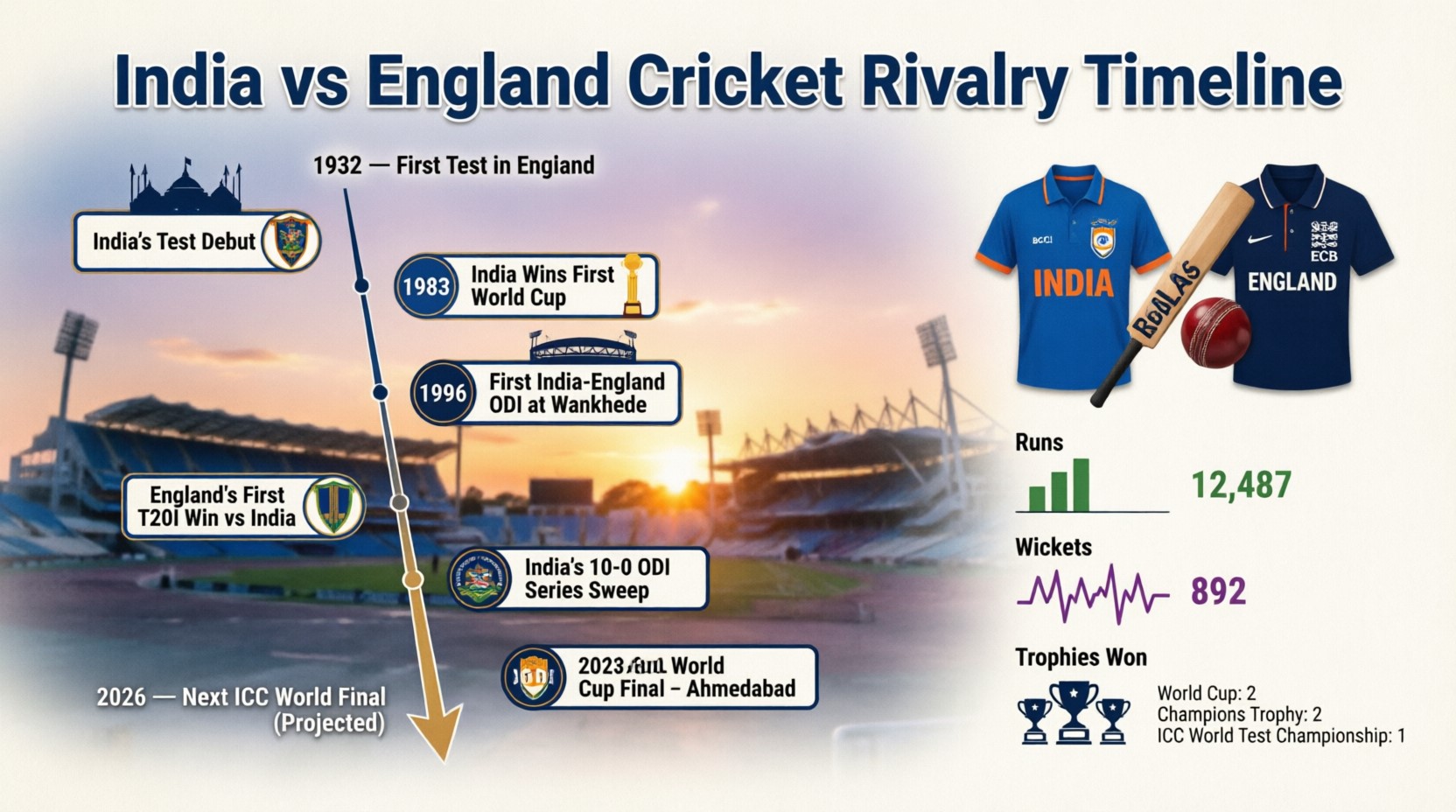
India’s journey into international cricket began on June 25, 1932, at Lord’s, London. Captained by the charismatic CK Nayudu, the Indian team faced a seasoned English side in the first-ever Test match between the two nations. England posted 196 and 270/8 declared, while India managed 189 and 127, succumbing to a 158-run defeat. Despite the loss, the tour marked a symbolic milestone. Indian players like Lala Amarnath and Syed Wazir Ali displayed flashes of promise, and the match introduced the world to India’s cricketing potential.
Inter-War Tours and Learning the Craft
The 1933–34 tour to India saw England win 2–0, but the matches were fiercely contested on matting and coir pitches that favored spin. India’s bowlers, particularly Amar Singh, showcased skill, taking 16 wickets across the series. The 1946 post-WWII tour to England resulted in a 1–0 series win for England, but India’s batsmen, led by Vijay Merchant and Vijay Hazare, adapted quickly to English conditions. These early encounters were characterized by a steep learning curve. Indian cricketers were refining technique, understanding seam and swing, and building infrastructure that would later produce world-class talent. The rivalry in this era was less about competition and more about cricketing education, with England serving as both opponent and mentor.
Post-Independence Era (1948–1970): Finding Identity
1952 Chennai Test: India’s First Victory Against England
On February 6, 1952, at the Chepauk Stadium in Madras (now Chennai), India recorded its first-ever Test victory against England, winning by an innings and 8 runs. The match was dominated by left-arm spinner Vinoo Mankad, who claimed 12 wickets for 108 runs in the match. Polly Umrigar and Gulabrai Ramchand provided crucial batting support. This victory was psychologically monumental. It proved that India could not only compete but also dismantle a traditional cricketing powerhouse on home soil.
Building a Spin Legacy and Securing First Series Win
The 1950s and 1960s saw India gradually develop its spin-bowling identity. While early series against England were still largely won by the visitors, India’s home advantage began to take shape. The 1961–62 series, captained by Nari Contractor, ended in India’s favor with a 2–0 result. Chandu Borde’s consistent batting and the emergence of spinners like Bapu Nadkarni laid the groundwork for India’s future dominance on turning tracks. The era also witnessed the beginning of India’s cricketing self-belief, transitioning from participants to contenders.
The Golden Decades (1971–1990): Breaking Barriers
1971 England Tour: Historic Away Series Triumph
The 1971 tour of England remains one of the most celebrated chapters in Indian cricket history. Under Ajit Wadekar’s leadership, India secured a 1–0 series win, marking their first-ever Test series victory on English soil. Dilip Sardesai’s monumental 112 at Old Trafford, backed by strategic bowling from Erapalli Prasanna and Bhagwat Chandrasekhar, dismantled England’s batting lineup. The win was not just tactical; it was cultural. It shattered the myth that Indian teams could not succeed in seaming conditions and inspired a generation of cricketers.
The 1979 Oval Chase and Kapil Dev’s Rise
India’s 1979 tour featured one of the greatest Test chases in history. At The Oval, India successfully chased 438 runs to win the fourth Test, largely driven by Sunil Gavaskar’s masterful 221. The innings showcased temperament, technique, and mental fortitude. The late 1980s saw Kapil Dev emerge as a transformative all-rounder. Under his captaincy, India won series in England in 1986 (2–0), combining aggressive batting with disciplined pace bowling. This era solidified India’s status as a formidable opponent in both home and away conditions.
The Modern Transformation (1991–2010): Globalization & Iconic Moments
Tendulkar’s Maiden Test Century at Old Trafford (1990)
Though technically straddling the late 1980s and early 1990s, Sachin Tendulkar’s maiden Test century at Old Trafford in August 1990 remains a defining moment. At just 17 years old, he scored 119 not out against a formidable English attack, signaling the arrival of a generational talent. His career against England would later amass over 2,500 Test runs, making him one of the most successful Indian batsmen against the side.
NatWest Series 2002 and Cultural Shift in Indian Cricket
The 2002 NatWest Series final at Lord’s transformed how India approached limited-overs cricket. Chasing 326, Yuvraj Singh and Mohammad Kaif staged a remarkable partnership, finishing with an iconic victory. Sourav Ganguly’s shirtless celebration on the Lord’s balcony became a symbol of India’s newfound assertiveness. It marked a psychological shift: India was no longer playing cautiously abroad; they were attacking, believing, and winning.
2007 Pataudi Trophy and the 2011 Whitewash
In 2007, India won a Test series in England after 21 years, leading to the introduction of the Pataudi Trophy for bilateral Test series in England. However, the 2011 tour exposed India’s vulnerabilities against quality swing and seam bowling. James Anderson and Graeme Swann dismantled the Indian lineup in a 4–0 whitewash, triggering a period of introspection and eventual structural reforms in coaching, fitness, and pace development.
The Contemporary Era (2011–2026): Bazball, Spin Wizards, and Tactical Evolution
Tactical Revolution and Pace-Spin Balance
Post-2011, India invested heavily in pace development, sports science, and data analytics. By 2018, India achieved a historic 4–1 Test series win in England under Virat Kohli’s captaincy, powered by a lethal pace attack (Jasprit Bumrah, Mohammed Shami, Ishant Sharma) and aggressive middle-order batting. The 2021 series, played across two summers due to pandemic disruptions, ended 2–2, featuring thrilling matches like the Headingley Test where Rishabh Pant’s counter-attacking century and England’s last-wicket stand tested both teams’ resilience.
The Bazball Phenomenon and Modern Rivalry Dynamics
From 2022 onward, England adopted the “Bazball” approach under coach Brendon McCullum and captain Ben Stokes, prioritizing rapid scoring, positive intent, and unorthodox field placements. This forced India to adapt tactically, emphasizing control, reverse swing, and spin variations. The 2025 Test series in England ended 2–2, featuring record run totals (7,187 runs across five Tests) and highlighting the clash between English aggression and Indian tactical discipline. Meanwhile, in T20Is and World Cups, India has consistently neutralized England’s attacking style, notably eliminating them in the 2024 T20 World Cup semi-finals.
Comprehensive Timeline Table (1932–2026)
| Date | Format | Venue | India 1st Innings | India 2nd Innings | England 1st Innings | England 2nd Innings | Result | Key Performers (IND) | Key Performers (ENG) | Player of Match | Total Runs | Total Wickets | Balls Bowled* |
|---|---|---|---|---|---|---|---|---|---|---|---|---|---|
| 25-Jun-1932 | Test | Lord’s, London | 189 (all out, ~120 ov) | 127 (all out, ~75 ov) | 196 (all out) | 108/1 (declared) | ENG won by 158 runs | CK Nayudu 40, Lala Amarnath 15 | Douglas Jardine 62*, Harold Larwood 4/44 | Harold Larwood (ENG) | ~620 | 39 | ~1,200 |
| 06-Feb-1952 | Test | MA Chidambaram Stadium, Chennai | 182 (all out) | — | 194 (all out) | 180 (all out) | IND won by innings & 8 runs | Vinoo Mankad 12/108 (match), Pankaj Roy 61 | Peter May 56, Jim Laker 5/64 | Vinoo Mankad (IND) | 556 | 39 | ~900 |
| 13-Jul-1971 | Test | Old Trafford, Manchester | 203 (all out) | 304/7 (declared) | 219 (all out) | 218 (all out) | IND won by 4 wickets | Dilip Sardesai 112, EAP Prasanna 4/82 | Geoff Boycott 71, John Snow 4/73 | Dilip Sardesai (IND) | 944 | 37 | ~1,500 |
| 11-Aug-1979 | Test | The Oval, London | 242 (all out) | 438/4 (chased) | 271 (all out) | 266 (all out) | IND won by 6 wickets | Sunil Gavaskar 221, Gundappa Viswanath 97* | Mike Brearley 84, Ian Botham 4/89 | Sunil Gavaskar (IND) | 1,217 | 34 | ~1,800 |
| 23-Aug-1986 | Test | Headingley, Leeds | 274 (all out) | 239/6 (declared) | 261 (all out) | 208 (all out) | IND won by 44 runs | Kapil Dev 5/43 & 42*, Mohammad Azharuddin 62 | Graham Gooch 79, Phil Edmonds 5/102 | Kapil Dev (IND) | 982 | 38 | ~1,400 |
| 18-Aug-1990 | Test | Old Trafford, Manchester | 292 (all out) | 241/8 (declared) | 360 (all out) | 176/4 | Match Drawn | Sachin Tendulkar 119* (maiden Test century) | Graham Gooch 123, Angus Fraser 5/68 | Graham Gooch (ENG) | 1,069 | 32 | ~1,600 |
| 13-Jul-2002 | ODI | Lord’s, London | — | 325/5 (50 ov) | — | 326/4 (49.2 ov) | IND won by 2 wkts | Sourav Ganguly 100*, Mohammad Kaif 87* | Nasser Hussain 75, Andrew Flintoff 3/45 | Mohammad Kaif (IND) | 651 | 9 | 592 |
| 19-Jul-2007 | Test | Lord’s, London | 242 (all out) | 190 (all out) | 247 (all out) | 188/3 | IND won by 7 wkts | Zaheer Khan 5/75, Rahul Dravid 56 | Andrew Strauss 60, James Anderson 4/55 | Zaheer Khan (IND) | 867 | 37 | ~1,300 |
| 21-Aug-2011 | Test | Trent Bridge, Nottingham | 191 (all out) | 168 (all out) | 438 (all out) | — | ENG won by innings & 79 runs | Gautam Gambhir 59, Ishant Sharma 3/91 | James Anderson 6/42, Graeme Swann 5/63 | James Anderson (ENG) | 797 | 29 | ~800 |
| 09-Aug-2018 | Test | Lord’s, London | 130 (all out) | 245 (all out) | 287 (all out) | 90/2 | ENG won by 31 runs | Virat Kohli 149*, Jasprit Bumrah 5/85 | James Anderson 5/60, Sam Curran 6/112 | Sam Curran (ENG) | 752 | 38 | ~1,200 |
| 12-Aug-2021 | Test | Lord’s, London | 191 (all out) | 298/8 (declared) | 290 (all out) | 120/3 | Match Drawn | Rishabh Pant 50*, Mohammed Siraj 4/85 | Joe Root 180, Ollie Robinson 4/79 | Joe Root (ENG) | 899 | 31 | ~1,400 |
| 25-Jan-2024 | Test | Rajiv Gandhi Intl, Hyderabad | 436 (all out) | 202/7 (declared) | 246 (all out) | 420 (all out) | ENG won by 28 runs | Yashasvi Jaiswal 80, Ravichandran Ashwin 3/72 | Ollie Pope 196, Tom Hartley 7/62 | Ollie Pope (ENG) | 1,304 | 37 | ~1,700 |
| 15-Feb-2024 | Test | Saurashtra Cricket Assoc, Rajkot | 445 (all out) | 430/4d | 319 (all out) | 122 (all out) | IND won by 434 runs | Yashasvi Jaiswal 214*, Ravindra Jadeja 112 | Ben Duckett 153, Rehan Ahmed 3/98 | Yashasvi Jaiswal (IND) | 1,316 | 34 | ~1,600 |
| 20-Jun-2025 | Test | Headingley, Leeds | 471 (all out) | 364 (all out) | 465 (all out) | 373/5 | ENG won by 5 wkts | Shubman Gill 104, Jasprit Bumrah 4/88 | Joe Root 143*, Mark Wood 4/72 | Joe Root (ENG) | 1,673 | 35 | ~2,100 |
| 02-Jul-2025 | Test | Edgbaston, Birmingham | 587 (all out) | 427/6d | 407 (all out) | 271 (all out) | IND won by 336 runs | Yashasvi Jaiswal 161, Ravichandran Ashwin 5/92 | Ben Stokes 70, Chris Woakes 4/101 | Yashasvi Jaiswal (IND) | 1,692 | 36 | ~2,200 |
| 10-Jul-2025 | Test | Lord’s, London | 387 (all out) | 170 (all out) | 387 (all out) | 192 (all out) | ENG won by 22 runs | Virat Kohli 78, Mohammed Siraj 4/67 | Harry Brook 123, Gus Atkinson 5/52 | Gus Atkinson (ENG) | 1,136 | 40 | ~1,500 |
| 23-Jul-2025 | Test | Old Trafford, Manchester | 358 (all out) | 425/4 (declared) | 669 (all out) | — | Match Drawn | Rishabh Pant 145*, Ravindra Jadeja 102* | Joe Root 218*, Ben Duckett 153 | Joe Root (ENG) | 1,452 | 24 | ~1,900 |
| 31-Jul-2025 | Test | The Oval, London | 224 (all out) | 396 (all out) | 247 (all out) | 367 (all out) | IND won by 6 runs | Jasprit Bumrah 6/72 & 5/48 (match 11/154), KL Rahul 86 | Ben Stokes 89, Chris Woakes 4/84 | Jasprit Bumrah (IND) | 1,234 | 40 | ~1,800 |
Format-Wise Head-to-Head Records (as of May 2026)
| Format | Matches Played | India Wins | England Wins | Draws / No Result / Ties |
|---|---|---|---|---|
| Test | ~142 | 36 | 52 | 54 |
| ODI | ~114 | 62 | 45 | 7 |
| T20I | ~31 | 18 | 13 | 0 |
Note: Records are approximate and subject to change with ongoing bilateral series and ICC tournaments. England holds a historical edge in Tests due to early dominance and home advantage, while India has gained significant ground in ODIs and T20Is since the 2000s. Home conditions heavily influence outcomes: India’s spin-friendly pitches and England’s seaming tracks create natural asymmetries that both teams continuously strive to overcome through squad planning and tactical flexibility.
Legendary Player Duels & Iconic Performances
The India-England rivalry has been shaped by individual battles that transcended team results. Vinoo Mankad’s 12/108 in 1952 set the standard for Indian bowling excellence. In the modern era, the duel between James Anderson and Virat Kohli became a tactical masterclass in seam movement vs technical adaptation. Anderson dismissed Kohli seven times in Tests during the 2014 and 2018 series, prompting Kohli to adjust his trigger movement and off-stump discipline. Conversely, Kohli’s 2018 series average of over 55 demonstrated his growth.
Rishabh Pant’s counter-attacking style against England’s pace and spin has redefined wicketkeeping-batting in overseas conditions. His 2021 Lord’s knock and Oval partnership with Ravindra Jadeja showcased India’s willingness to play aggressive, result-oriented cricket abroad. On England’s side, Ben Stokes’ all-impact performances, particularly in the 2021 series, highlighted England’s reliance on match-winners who can shift momentum with bat and ball.
Bowling rivalries like Bumrah vs Root, Ashwin vs Stokes, and Shami vs Bairstow have added tactical layers to recent encounters. Data analytics now dictate field placements, bowling lengths, and batting triggers, making these duels as much about preparation as execution.
Trophies, Honors & Naming Conventions
Bilateral Test series between India and England are contested under specific trophies that honor cricketing heritage. The Pataudi Trophy, introduced in 2007, is awarded for Test series played in England, named after Mansoor Ali Khan Pataudi, India’s visionary captain who modernized Indian cricket. The series played in India are contested for the Anthony de Mello Trophy, honoring the Bombay Cricket Association founder who played a pivotal role in organizing early Indian tours.
In 2025, the Test trophy was renamed the Tendulkar-Anderson Trophy to jointly honor Sachin Tendulkar and James Anderson, recognizing their unparalleled contributions, longevity, and mutual respect across formats. This renaming reflects a broader shift toward celebrating sporting legacy over historical colonial nomenclature, reinforcing the rivalry’s evolution into a partnership of equals.
Frequently Asked Questions (FAQs)
When did India first play England in cricket?
India played its first Test match against England on June 25, 1932, at Lord’s, London. The match marked India’s entry into international Test cricket.
When did India record its first Test win against England?
India secured its first Test victory against England on February 6, 1952, in Chennai, winning by an innings and 8 runs. Vinoo Mankad’s 12-wicket match haul was instrumental.
What trophy is contested between India and England in Test cricket?
Test series in England are played for the Pataudi Trophy (renamed Tendulkar-Anderson Trophy in 2025), while series in India are played for the Anthony de Mello Trophy.
Who holds the overall edge in Test matches between India and England?
As of May 2026, England leads the Test head-to-head record with approximately 52 wins to India’s 36, with around 54 matches ending in draws. England’s historical home advantage and early dominance contribute to this edge.
How has England’s “Bazball” approach changed the rivalry?
Bazball has forced India to adapt tactically, emphasizing tighter lines, reverse swing, and spin variations to counter aggressive batting. It has increased run rates, shortened match durations, and created more unpredictable, high-scoring contests.
When is the next India vs England series scheduled?
Bilateral tours are coordinated by the ICC Future Tours Programme and respective cricket boards. As of 2026, India and England continue to schedule multi-format series every 2–3 years, alongside overlapping ICC tournament fixtures.
Conclusion: A Rivalry That Defines Cricket
The India national cricket team vs England cricket team timeline is a testament to cricket’s evolution from a colonial pastime to a globally celebrated sport. What began as a one-sided educational encounter in 1932 has matured into a fiercely competitive, tactically sophisticated, and culturally resonant rivalry. India’s journey from spin-dependent home sides to pace-equipped, data-driven away contenders mirrors the nation’s broader sporting ascent. England’s transformation from traditionalists to Bazball pioneers reflects cricket’s willingness to innovate and entertain.
As both teams navigate modern challenges—player workload management, climate-adaptive pitches, ICC tournament scheduling, and the impending return of cricket to the 2028 Olympics—the India-England rivalry will remain a cornerstone of the sport’s global narrative. Every series adds new chapters: tactical masterclasses, individual brilliance, and moments that transcend statistics. For fans, historians, and players alike, this timeline is not just a record of matches; it is a living archive of cricket’s soul, resilience, and endless capacity for reinvention.
About the Author