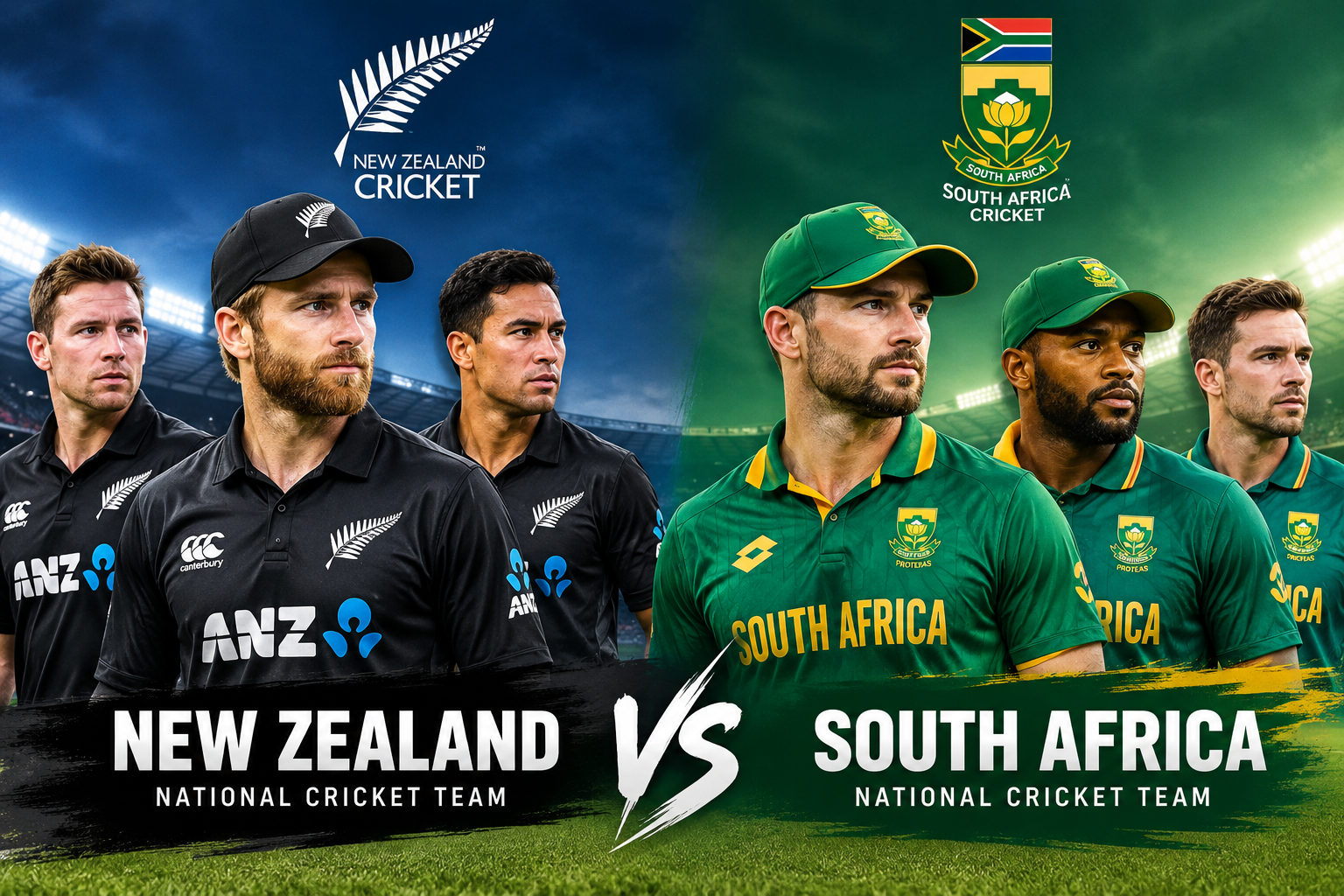
new zealand national cricket team vs south africa national cricket team players
Introduction: New Zealand National Cricket Team vs South Africa National Cricket Team Players
When New Zealand and South Africa meet in international cricket, the contest is often decided by a handful of individual performances. The Black Caps usually win through discipline, clever captaincy and bowlers who exploit helpful conditions. The Proteas tend to rely on raw pace, power hitting and a deep batting order. This guide covers the players on both sides, from established match-winners to the newer names who have been tried in recent series, along with the context that explains why these matches matter. The squad details come from the 2026 fixtures, including the T20 World Cup semi-final and the T20I series in New Zealand. Selection changes from series to series, so check official squad announcements before relying on any single line-up.
Table of Contents
New Zealand vs South Africa: A Rivalry Built on Contrasts
A Short History of the Contest
The two nations have played each other for decades across Tests, ODIs and T20Is, and the rivalry has grown more competitive since South Africa returned to international cricket in the early 1990s. South Africa have often had the stronger overall record in white-ball cricket, and one preview of the 2026 series noted they led the T20I head-to-head by 12 matches to 8. New Zealand have repeatedly beaten that trend on home soil, though. The same preview noted that South Africa had not beaten New Zealand in a T20I in New Zealand since 2017. That home advantage matters. New Zealand’s grounds offer swing, seam movement and short boundaries, which suit bowlers who hit a good length and punish batters who play loosely early on.
Recent Big Matches
The most recent high-profile meeting was the ICC Men’s T20 World Cup 2026 semi-final at Eden Gardens in Kolkata. New Zealand won that match by 9 wickets. The result showed how effective the Black Caps’ balanced approach can be against a South African side full of stars. Soon afterwards, the two teams met again in a bilateral T20I series in New Zealand, where both sides rotated their squads heavily after a long World Cup campaign. That series gave selectors on both sides a chance to look at fringe players, which makes it a useful source of names for anyone following the sport closely.
Why This Rivalry Matters
Matches between these teams are rarely one-sided. Both nations have a reputation for producing well-prepared, hard-working cricketers rather than relying on a single superstar, and both have spent years fighting to be taken as seriously as the biggest cricket nations. That shared underdog identity gives the contest an edge. It also means fans get to see a wide range of styles in one match, from New Zealand’s patient accumulation and tactical bowling changes to South Africa’s aggressive starts and express pace. For neutral viewers, that contrast is a big part of the appeal.
New Zealand National Cricket Team Players
Top-Order Batters
New Zealand’s batting has long been built around technically sound top-order players who value patience, with a few aggressive options added in limited-overs formats. Devon Conway is the clearest example. He was born in Johannesburg, so playing South Africa carries extra interest for him, and he has been one of the Black Caps’ most reliable openers across formats. His ability to rotate strike and then accelerate makes him valuable in T20Is. Tim Seifert, a wicketkeeper-batter who was in the T20 World Cup semi-final squad, offers a more explosive style at the top or in the middle order. Tim Robinson, who featured in the March T20I series, represents the next generation of New Zealand batters and has been given opportunities to prove himself when senior players are rested.
Rachin Ravindra is one of the most exciting young players in world cricket. His name is famously a blend of Rahul Dravid and Sachin Tendulkar, and he has justified the comparison with elegant strokeplay and useful left-arm spin. Daryl Mitchell is a powerful middle-order batter who has become one of New Zealand’s most dependable performers under pressure, often finishing innings or rebuilding them after early wickets. Both players are central to how the Black Caps approach big tournament games.
Wicketkeepers and Experienced Names
Tom Latham, the left-handed opener and wicketkeeper, has been a long-serving figure for New Zealand and has captained the side in Tests. He was part of the March T20I squad. Dane Cleaver is another wicketkeeper-batter who has been selected in recent squads, showing that New Zealand are building depth in that department. Nick Kelly and Katene Clarke also appeared in the squad lists for the T20I series, giving the selectors extra batting options.
All-Rounders
New Zealand have a tradition of producing useful all-rounders, and the 2026 squads reflect it. Glenn Phillips is one of the best fielders in the world and a destructive middle-order hitter who also bowls handy off-spin. James Neesham is a hard-hitting finisher whose medium pace and big-match experience make him a valuable T20 specialist. Mitchell Santner is the left-arm spinner who also leads the side in limited-overs cricket, and his economical bowling and calm captaincy are a big part of New Zealand’s identity. Cole McConchie, Josh Clarkson and Zak Foulkes were also named in the March series squad, adding further depth. Ish Sodhi, the leg-spinner, has long been a wicket-taking threat in T20 cricket, and his googlies are a key weapon against right-handed hitters.
Pace and Spin Bowlers
Kyle Jamieson stands out for his height and bounce, which let him extract steep lift from even flat pitches. Ben Sears is another quick bowler who has featured in recent T20I squads, and Lockie Ferguson brings sheer speed that few bowlers in world cricket can match. Jayden Lennox and Nathan Smith were also among the bowlers named in the squad lists. Taken together, the bowling group gives New Zealand a flexible attack. They can go heavy on pace in seaming conditions or lean on spin when pitches slow down, as they often do in the subcontinent.
South Africa National Cricket Team Players
Batters and Wicketkeepers
South Africa’s batting depth is one of their biggest strengths. Aiden Markram, listed as captain in the T20 World Cup semi-final squad, is a stylish top-order batter who also bowls part-time off-spin and leads by example. Quinton de Kock is an aggressive wicketkeeper-batter who can take a game away from the opposition in the powerplay, and his return to the T20 side added experience and power. Ryan Rickelton is a left-handed wicketkeeper-batter who has made a strong impression since his international debut. Tristan Stubbs is a hard-hitting middle-order player with an unusual, powerful technique.
Tony de Zorzi, who featured in the March T20I series, is a left-hander who has been developing as a limited-overs option after earlier success in Tests. Connor Esterhuizen and Rubin Hermann, both wicketkeepers, were named in the series squad, as were Jason Smith, a batter, and Jordan Hermann. These names suggest South Africa are investing in options for the future rather than relying only on their established stars.
All-Rounders
Marco Jansen is one of the most valuable players South Africa have. At roughly 6 feet 8 inches, he offers left-arm pace with steep bounce and can hit the ball a long way down the order. Corbin Bosch is another fast-bowling all-rounder who was part of the World Cup semi-final squad. George Linde, the left-arm spinner who also bats, is a crucial economical option in the middle overs. Wiaan Mulder is a tall seam-bowling all-rounder who made headlines in 2025 by scoring a huge unbeaten innings in a Test against Zimbabwe, and he appeared in the March T20I squad too. Dian Forrester and Prenelan Subrayen were also included, rounding out the group of all-rounders.
Pace and Spin Attack
South Africa have always produced exceptional fast bowlers, and the current group continues that tradition. Gerald Coetzee is a fast, aggressive bowler who generates sharp pace and bounce. Ottniel Baartman is a left-arm quick who brings variety to the attack. Nqobani Mokoena is a young name who was highlighted in preview coverage, and Andile Simelane and Lutho Sipamla were also in the squad as pace options. Keshav Maharaj, the left-arm spinner, is among the most reliable spin bowlers in the world across formats and often leads the spin attack with intelligent variations and consistent control.
Squads From the March 2026 Series
New Zealand’s Playing Group
The playing XI for the second T20I included Devon Conway, Tom Latham, Tim Robinson, Nick Kelly, Mitchell Santner, James Neesham, Cole McConchie, Josh Clarkson, Kyle Jamieson, Ben Sears and Lockie Ferguson. That shows how New Zealand blended experienced campaigners with newer options, keeping a balance between batting depth and bowling variety.
South Africa’s Playing Group
South Africa’s side for the same match included Wiaan Mulder, Connor Esterhuizen, Tony de Zorzi, Rubin Hermann, Jason Smith, Dian Forrester, George Linde, Gerald Coetzee, Keshav Maharaj, Nqobani Mokoena and Ottniel Baartman. Compared with their World Cup line-up, this was a very different group, which is why the series was seen as a chance to test depth rather than a straight contest between full-strength teams.
Key Player Battles to Watch
Openers vs New-Ball Bowlers
The opening overs often decide matches between these two teams. Devon Conway and Tim Seifert against Marco Jansen and Gerald Coetzee is the kind of matchup that sets the tone. Jansen’s left-arm angle and bounce can trouble right-handers, while Conway’s patience and placement are exactly what a new-ball bowler hates to see. At the other end, Quinton de Kock and Ryan Rickelton against Kyle Jamieson and Lockie Ferguson is a test of whether South Africa’s aggressive starts can survive New Zealand’s pace and bounce.
Spinners in the Middle Overs
Mitchell Santner and Ish Sodhi against Aiden Markram and Tristan Stubbs is one of the most interesting middle-overs contests. Santner’s accuracy tends to dry up runs, while Sodhi looks for wickets with variation. South Africa’s batters will want to attack Sodhi early and avoid giving Santner easy dot balls. In the other direction, Keshav Maharaj and George Linde against Daryl Mitchell and Glenn Phillips tests whether New Zealand’s power hitters can handle left-arm spin that rarely offers width.
Strengths and Weaknesses of Both Sides
New Zealand
New Zealand’s greatest strength is balance. They have all-rounders who contribute in several ways, bowlers who adapt to conditions, and a culture of strong fielding and smart captaincy. Their weakness is that depth can thin out when several senior players are rested, as happened in the March T20I series. Without their biggest names they can look less threatening, particularly against a rival with a lot of power in the batting order.
South Africa
South Africa’s strength is firepower. They have hitters who can end a game in a few overs and fast bowlers who can win a match in a single spell. Their historical weakness has been handling pressure in knockout matches, which explains why the semi-final defeat to New Zealand will hurt. A second concern is consistency when they rotate the squad, because several newer names are still building international experience.
Women’s Cricket: New Zealand vs South Africa
The women’s teams are also worth following. New Zealand’s squad for the March 2026 women’s T20Is featured Sophie Devine, Amelia Kerr, Suzie Bates, Georgia Plimmer, Izzy Gaze and Maddy Green. South Africa’s side featured Laura Wolvaardt, Tazmin Brits, Sune Luus, Nadine de Klerk and Chloe Tryon. Kerr is one of the best all-rounders in the women’s game, and Wolvaardt is one of its most elegant and prolific batters, so their individual duels are among the highlights of any series between the two nations.
Frequently Asked Questions
Who is the captain of South Africa in T20 cricket?
Aiden Markram was listed as captain in the T20 World Cup 2026 semi-final squad.
Who is New Zealand’s key spinner?
Mitchell Santner is the left-arm spinner who also leads the team in limited-overs cricket, and Ish Sodhi is the main leg-spin option.
Who won the T20 World Cup 2026 semi-final between the two teams?
New Zealand won by 9 wickets in the semi-final in March 2026.
Which player in the New Zealand squad was born in South Africa?
Devon Conway plays for New Zealand but was born in Johannesburg, South Africa, which gives matches between the two sides extra interest.
Are the squads always the same?
No. Both teams rotate players depending on format, workload and conditions, so always check the latest squad announcement before a match.
Conclusion
New Zealand and South Africa meet as two well-matched sides with different identities. New Zealand rely on balance, fielding and tactical sharpness, with players like Devon Conway, Daryl Mitchell, Rachin Ravindra, Glenn Phillips, Mitchell Santner and Kyle Jamieson. South Africa counter with power and pace through Aiden Markram, Quinton de Kock, Marco Jansen, Tristan Stubbs, Gerald Coetzee and Keshav Maharaj. The 2026 semi-final and the following T20I series showed how quickly the balance can shift when squads are rotated. For fans, the best approach is to follow official announcements, watch how the new faces develop, and enjoy a rivalry that rarely disappoints.
About the Author