Cricket Rules And Changes
Introduction
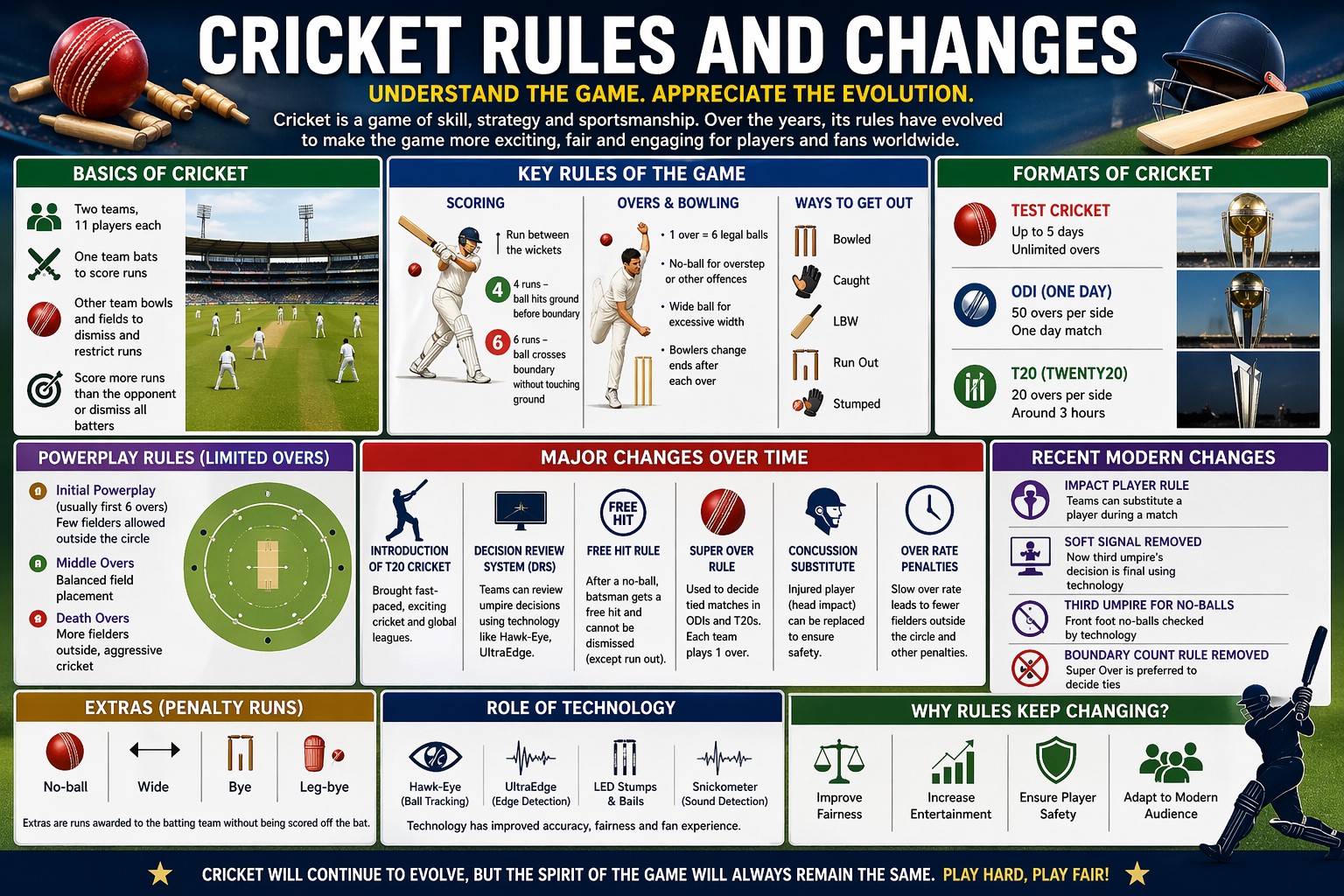
Cricket is one of the most widely followed and passionately played sports in the world, especially in countries like India, England, Australia, and South Africa. Governed by the International Cricket Council, the sport has evolved over centuries while maintaining its traditional roots. From village greens to massive international stadiums, cricket has transformed into a global phenomenon that combines skill, strategy, and entertainment. Understanding cricket rules and changes is essential not only for players but also for fans who want to fully enjoy and appreciate the game. Over time, several rules have been modified or introduced to make cricket faster, fairer, and more engaging for modern audiences, and this article provides a complete and detailed explanation of both the core rules and the major changes that have shaped the game.
Understanding the Basics of Cricket
Cricket is played between two teams, each consisting of eleven players, on a large circular or oval field with a rectangular pitch at the center. The game revolves around two main activities: batting and bowling. One team bats to score runs while the other bowls and fields to restrict scoring and dismiss players. The match is divided into innings, and depending on the format, each team may bat once or twice. The basic objective is simple but deeply strategic: score more runs than the opposition or dismiss all opposing batsmen before they can surpass your total. Despite its simple objective, cricket involves a complex set of rules and strategies that make it both challenging and exciting.
Key Rules of Cricket
Batting Rules and Scoring System
Batting is at the heart of cricket, and it is where most runs are generated. A batsman uses a bat to hit the ball delivered by the bowler and attempts to score runs either by running between the wickets or by hitting the ball to the boundary. When the ball crosses the boundary after touching the ground, it results in four runs, while a ball that crosses the boundary without touching the ground earns six runs. Batsmen must remain alert and coordinate effectively while running between the wickets because a small mistake can lead to a run-out. Apart from boundaries and running, batsmen also rely on timing, placement, and technique to maximize scoring opportunities and put pressure on the fielding side.
Bowling Rules and Techniques
Bowling is equally important, as it is the primary way to dismiss batsmen and control the flow of runs. A bowler delivers the ball overarm towards the batsman, aiming to either hit the stumps or force an error. Each over consists of six legal deliveries, and any violation such as overstepping the crease results in a no-ball, while deliveries too wide of the batsman are called wides. Bowlers use a variety of techniques, including pace, swing, seam, and spin, to outsmart batsmen. The rotation of bowlers and the strategic use of different bowling styles play a crucial role in the outcome of the game, making bowling a highly tactical aspect of cricket.
Fielding Rules and Responsibilities
Fielding is often underrated but is a critical component of cricket. Fielders are responsible for stopping runs, catching balls, and assisting in dismissals like run-outs and stumpings. Good fielding can save crucial runs and shift momentum in favor of the bowling team. Fielders must be quick, agile, and accurate in their throws, while the wicketkeeper plays a specialized role behind the stumps, often involved in catches and stumpings. Effective field placement and coordination among players are essential to restrict scoring and create pressure on the batting side.
Ways a Batsman Can Get Out
A batsman can be dismissed in several ways, each adding a different layer of complexity to the game. The most common method is being bowled, where the ball hits the stumps and dislodges the bails. A batsman can also be caught if a fielder catches the ball before it touches the ground. LBW, or leg before wicket, occurs when the ball hits the batsman’s leg in line with the stumps, preventing it from hitting the wicket. Run-outs happen when the batsman fails to reach the crease before the stumps are broken, while stumpings occur when the wicketkeeper removes the bails while the batsman is outside the crease. These different dismissal methods make cricket a game of both skill and precision.
Formats of Cricket
Test Cricket
Test cricket is the longest and most traditional format of the game, played over five days with unlimited overs. Each team gets two innings, and the format emphasizes patience, endurance, and strategy. Test cricket is often considered the ultimate test of a player’s skill and temperament, as it requires sustained performance over a long period.
One Day Internationals (ODIs)
ODIs are limited-overs matches where each team faces a maximum of 50 overs. This format strikes a balance between the traditional and modern styles of cricket, offering both strategic depth and faster gameplay. ODIs gained immense popularity due to their ability to produce exciting results within a single day.
Twenty20 (T20) Cricket
T20 cricket is the shortest and most fast-paced format, with each team playing only 20 overs. It is designed to maximize entertainment and attract a broader audience. Leagues such as the Indian Premier League have revolutionized this format, making it one of the most popular forms of cricket worldwide.
Fielding Restrictions and Powerplays
Powerplays are specific periods in limited-overs cricket during which fielding restrictions are applied. These restrictions limit the number of fielders allowed outside a designated circle, encouraging aggressive batting and higher scoring rates. The initial overs typically have stricter restrictions, while the middle and final overs allow more flexibility. Powerplays add an extra layer of strategy, as teams must decide when to attack and when to consolidate their innings.
Extras and Penalties
Extras are additional runs awarded to the batting team due to errors by the bowling side. These include no-balls, wides, byes, and leg-byes. While they may seem minor, extras can significantly influence the outcome of a match, especially in closely contested games. Teams must maintain discipline to minimize extras and avoid giving away easy runs.
Major Changes in Cricket Over Time
Introduction of T20 Cricket
The introduction of T20 cricket marked a turning point in the history of the sport. It brought a new level of excitement and accessibility, making cricket more appealing to younger audiences and busy viewers. The shorter format also encouraged innovative batting techniques and aggressive gameplay, transforming the way cricket is played and consumed.
Decision Review System (DRS)
The Decision Review System is one of the most significant technological advancements in cricket. It allows teams to challenge umpire decisions using advanced tools like ball tracking and edge detection. DRS has improved the accuracy of decisions and reduced controversies, making the game fairer for both teams.
Free Hit Rule
The free hit rule was introduced in limited-overs cricket to penalize bowlers for no-balls. During a free hit, the batsman cannot be dismissed in most ways, encouraging aggressive shots and adding excitement to the game. This rule has become a key feature of modern cricket.
Concussion Substitute Rule
Player safety has become a priority in recent years, leading to the introduction of the concussion substitute rule. This allows a player who suffers a head injury to be replaced by a like-for-like substitute, ensuring that teams are not disadvantaged while protecting players’ health.
Super Over Rule
The Super Over is used to determine the winner in tied matches, particularly in T20 and ODI formats. Each team plays one over, and the team scoring more runs wins. This rule ensures clear results and adds a thrilling conclusion to closely fought matches.
Over Rate Penalties
To maintain the pace of the game, teams are required to complete their overs within a specified time. Failure to do so results in penalties such as fielding restrictions or fines. This rule ensures that matches progress efficiently and remain engaging for viewers.
Day-Night Test Matches
Day-night Test matches were introduced to make the longest format more appealing to modern audiences. Played under floodlights with a pink ball, these matches allow fans to attend games after work hours, increasing viewership and interest in Test cricket.
Recent Modern Changes in Cricket
Impact Player Rule
The impact player rule is a recent innovation that allows teams to substitute a player during a match. This adds a new dimension of strategy, as teams can adjust their lineup based on match conditions and situations.
Removal of Soft Signal
The soft signal, previously given by on-field umpires for close catches, has been removed. Now, the third umpire relies entirely on technological evidence, reducing confusion and improving decision accuracy.
Third Umpire Monitoring No-Balls
Front-foot no-balls are now monitored by the third umpire using technology, ensuring that no violations go unnoticed. This change has increased fairness and reduced the burden on on-field umpires.
Changes in Tie-Breaking Rules
The boundary count rule, once used to decide tied matches, has been removed following criticism. The Super Over is now the preferred method, ensuring a more competitive and fair outcome.
Role of Technology in Modern Cricket
Technology has become an integral part of cricket, enhancing both gameplay and viewer experience. Tools like Hawk-Eye, UltraEdge, and LED stumps have improved decision-making and added a new level of sophistication to the sport. These innovations not only make the game fairer but also provide fans with deeper insights and analysis.
Why Cricket Rules Continue to Evolve
Cricket rules continue to change to meet the demands of modern audiences and maintain the sport’s relevance. The need for faster gameplay, increased fairness, and better player safety drives these changes. Balancing tradition with innovation is a constant challenge, but it is essential for the growth and sustainability of the sport.
Conclusion
Cricket is a dynamic sport that has successfully adapted to changing times while preserving its core essence. From traditional Test matches to the fast-paced excitement of T20 cricket, the evolution of rules has played a crucial role in shaping the game. Understanding cricket rules and changes not only enhances your appreciation of the sport but also helps you stay connected with its ongoing developments. As cricket continues to evolve, it remains a source of joy, excitement, and unity for millions of fans around the world.
Frequently Asked Questions (FAQs)
What are the basic rules of cricket?
Cricket is played between two teams of eleven players, where one team bats to score runs and the other bowls and fields to restrict scoring and dismiss players.
What is the purpose of the DRS system?
DRS allows teams to review umpire decisions using technology, improving accuracy and reducing errors in crucial moments.
Why was T20 cricket introduced?
T20 cricket was introduced to make the game shorter, faster, and more entertaining, attracting a wider audience.
What is a Super Over in cricket?
A Super Over is a tie-breaking method where each team plays one over, and the team with more runs wins the match.
What is the Impact Player Rule?
It allows teams to substitute a player during a match, adding flexibility and strategic depth to the game.
How has technology changed cricket?
Technology has improved decision-making, reduced human errors, and enhanced the viewing experience with advanced analysis tools.
Read More: Iconic Cricket Matches: Legendary Games That Shaped Cricket History
About the Author