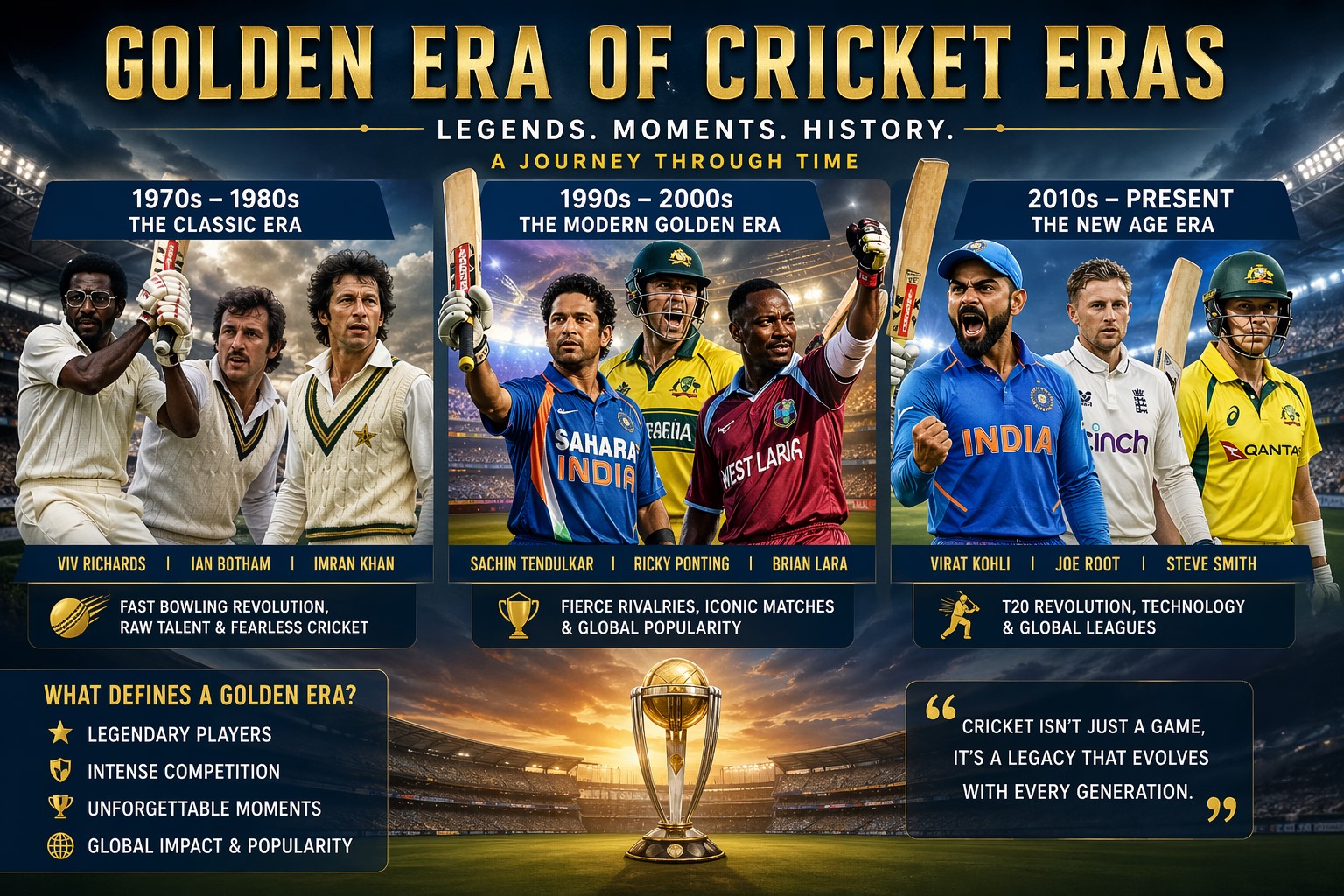
Golden Era Of Cricket Eras
Introduction
Cricket is more than just a sport—it is a legacy shaped by generations of players, unforgettable matches, and evolving styles of play. When people talk about the “Golden Era of Cricket,” they are referring to those special periods in the sport’s history when everything seemed to align perfectly: extraordinary talent, fierce competition, global attention, and unforgettable moments. However, what makes this concept fascinating is that there isn’t just one golden era. Instead, cricket has experienced multiple “golden phases,” each defined by its own unique characteristics, legendary players, and transformative developments.
From the dominance of the West Indies cricket team in the 1970s and 1980s to the global explosion of cricket in the late 1990s and 2000s, and finally to the modern, fast-paced T20-driven era, each period has contributed significantly to the game’s growth. This article explores these eras in detail, helping you understand what makes each one “golden” and why debates about the greatest era continue among fans and experts alike.
What Defines a Golden Era in Cricket?
Before diving into specific timelines, it is important to understand what actually defines a “Golden Era.” This is not an official label given by governing bodies but rather a perception shaped by fans, historians, and analysts.
A golden era typically includes several defining features. First, it is marked by the presence of multiple legendary players who dominate the sport and leave lasting legacies. Second, there is intense competition between teams, where no single side is unbeatable for too long. Third, the quality of cricket—whether in batting, bowling, or fielding—reaches exceptional levels. Lastly, the era often coincides with increased popularity and global reach of the game.
These factors combine to create periods that are remembered fondly and discussed for decades. Different generations of fans often have their own “golden era,” influenced by the players and matches they grew up watching.
The Classic Golden Era: 1970s to 1980s
Rise of Dominance and Aggression
The 1970s and 1980s are widely regarded as one of the earliest golden eras of cricket. This period was defined by aggression, raw talent, and the rise of fast bowling as a dominant force. The West Indies cricket team emerged as the most feared side in world cricket, with a pace attack that intimidated even the best batsmen.
This era saw the introduction of a more aggressive playing style, especially in Test cricket. Matches were no longer just about patience and technique; they became battles of skill, strategy, and mental toughness.
Legendary Players of the Era
Some of the greatest cricketers in history emerged during this period. Players like Viv Richards revolutionized batting with fearless stroke play, while Imran Khan combined leadership with all-round brilliance. Meanwhile, Ian Botham became a symbol of match-winning performances.
Fast bowlers like Dennis Lillee and his contemporaries brought a new level of intensity to the game. Their speed and aggression changed how cricket was played and viewed.
Evolution of Limited-Overs Cricket
This era also witnessed the growing popularity of One Day Internationals (ODIs). The Cricket World Cup, which began in 1975, started gaining traction, bringing a new audience to the sport and setting the stage for future innovations.
The Transitional Era: Early 1990s
A Shift in Balance
The early 1990s served as a transitional period between traditional cricket and the modern game. During this time, the dominance of teams like the West Indies began to fade, and new cricketing nations started to rise.
Teams such as the Australia national cricket team and the India national cricket team began building strong squads that would later dominate world cricket.
Technological and Structural Changes
This period also saw the introduction of new technologies and rules that improved fairness and viewer engagement. Television broadcasting became more advanced, bringing cricket into households around the world and increasing its global fan base.
The Modern Golden Era: Late 1990s to Late 2000s
The Most Celebrated Golden Era
For many fans, especially those who grew up during this time, the late 1990s to late 2000s represent the true golden era of cricket. This period combined the best elements of traditional and modern cricket, offering a perfect balance between skill, entertainment, and competition.
Multiple teams were strong at the same time, leading to highly competitive matches. No team was invincible, which made every series exciting and unpredictable.
Legendary Players Across Nations
This era featured an extraordinary collection of players who are still considered legends today. Sachin Tendulkar became a global icon, admired for his consistency and technique. Ricky Ponting led Australia with dominance and aggression, while Brian Lara mesmerized fans with his elegant stroke play.
All-rounders like Jacques Kallis provided balance to their teams, while bowlers such as Muttiah Muralitharan and Glenn McGrath dominated with skill and precision.
Intense Rivalries and Memorable Matches
This era was defined by intense rivalries. Matches between India and Australia, as well as Ashes series between England and Australia, became legendary. These contests were not just about winning but about pride and legacy.
Growth of Global Popularity
Cricket reached new heights of popularity during this time. Television coverage improved, sponsorship deals increased, and the sport expanded into new markets. This era laid the foundation for cricket’s modern commercial success.
The Rise of T20 and the New Age Era (2010s–Present)
A Revolution in Format
The introduction of T20 cricket transformed the sport entirely. Fast-paced, high-scoring matches attracted a younger audience and brought a new level of excitement. The Indian Premier League became one of the most successful cricket leagues in the world, blending entertainment with high-quality cricket.
Modern-Day Legends
The modern era has produced its own set of superstars. Players like Virat Kohli, Joe Root, Steve Smith, and Kane Williamson have carried the legacy forward.
These players excel across formats, adapting to the demands of Test, ODI, and T20 cricket.
Technology and Innovation
Modern cricket benefits from advanced technology such as Decision Review System (DRS), data analytics, and fitness tracking. These innovations have improved accuracy and performance, making the game more professional and competitive.
Comparing Different Golden Eras
Style of Play
The 1970s–80s focused on aggression and pace, while the 1990s–2000s balanced technique and entertainment. The modern era emphasizes speed, innovation, and adaptability.
Level of Competition
While earlier eras often saw dominance by a single team, later eras feature multiple strong teams, making the competition more balanced and unpredictable.
Fan Engagement
Modern cricket has significantly higher fan engagement due to social media, live streaming, and global leagues. However, older eras are remembered for their raw passion and authenticity.
Why the Debate Continues
The debate over the “true” golden era of cricket continues because it is deeply personal. Fans often associate the best era with their own experiences and memories. For some, it is about nostalgia; for others, it is about measurable achievements and statistics.
There is no definitive answer, and that is what makes cricket so fascinating. Each era has contributed something unique to the game, ensuring its continuous evolution.
The Lasting Impact of Golden Eras
Golden eras do more than just entertain—they shape the future of cricket. They inspire young players, influence playing styles, and set new standards of excellence. The legacy of past legends continues to influence modern cricketers, creating a continuous cycle of growth and innovation.
Conclusion
The concept of the “Golden Era of Cricket” is not limited to a single period. Instead, it represents multiple phases in the sport’s history where cricket reached exceptional heights. From the dominance of the 1970s and 1980s to the balanced brilliance of the late 1990s and 2000s, and finally to the fast-paced modern era, each phase has its own significance.
Rather than choosing one as the definitive golden era, it is more meaningful to appreciate how each period has contributed to making cricket the global phenomenon it is today. The beauty of cricket lies in its evolution, and its golden eras are a testament to its rich and dynamic history.
FAQs
1. What is meant by the “Golden Era of Cricket”?
The Golden Era refers to a period when cricket experienced exceptional quality, legendary players, intense competition, and high popularity among fans.
2. Which era is considered the best in cricket history?
Many fans consider the late 1990s to late 2000s as the best era due to balanced competition and iconic players, though opinions vary.
3. Why is the 1970s–1980s era important?
This era introduced aggressive cricket, dominant teams like the West Indies, and the rise of fast bowling as a key factor in the game.
4. How has T20 cricket changed the modern era?
T20 cricket has made the game faster, more entertaining, and globally popular, attracting new audiences and increasing commercial success.
5. Are we currently in a golden era of cricket?
Some believe the modern era is another golden phase due to technological advancements, global leagues, and multi-format excellence.
6. Why do opinions differ about cricket’s golden era?
Opinions differ because fans often base their views on personal experiences, favorite players, and the era they grew up watching.
Read More: Cricket Rules and Changes: Complete Guide
About the Author